My starting insight was the friction of digging straps, rolling waistbands and repeated adjustments. This is a creative hypothesis, not a quantified customer finding.
Underneat
Independent strategy exercise
Three campaign ideas for everyday comfort
Brand context · Independent exercise
Underneat
What they doAn Indian shapewear and innerwear brand co-founded by Kusha Kapila and Vimarsh Razdan.
Known forFit, comfort and movement, expressed through products and a candid consumer voice.
This is brand background; the case below is independent work, not an employment or client claim.I developed three ways to express comfort: a changed getting-home ritual, less product awareness and a wider cultural tension around adjustment.
The 27-slide deck includes the reasoning, films, social scripts, five occasion variations and product-category extensions, with a proposed creative brief and testing plan. No live campaign results are claimed.
Distinct creative territories
Proposed hero films and companion social formats
Insight, creative examples and proposed testing
The portfolio presentation · 27 slides
Comfort, through behaviour
All three territories with their reasoning, proposed hero films and social formats. Includes the full occasion range, product-category extensions and participation examples, followed by a creative brief and test plan. Underneat photography is clearly labelled brand reference.
Independent strategy exercise. Not commissioned by or affiliated with Underneat.
Explore the deck 01 / 27
Use the arrows to exploreMy creative territories
The full story
I developed three distinct campaign territories around the everyday interruptions of innerwear, each with a film idea and repeatable social format.
The insight behind the ideas
Comfort can become a story about behaviour, attention and expectations.
I began with the small interruptions people associate with uncomfortable innerwear: a strap that digs, a waistband that rolls or a cup that shifts. Each brings the product back into the wearer’s attention.
My creative question was how to make comfort feel recognisable rather than rely on a generic product adjective. I treated the situations as hypotheses to validate with customers, not as universal truths or completed research findings.
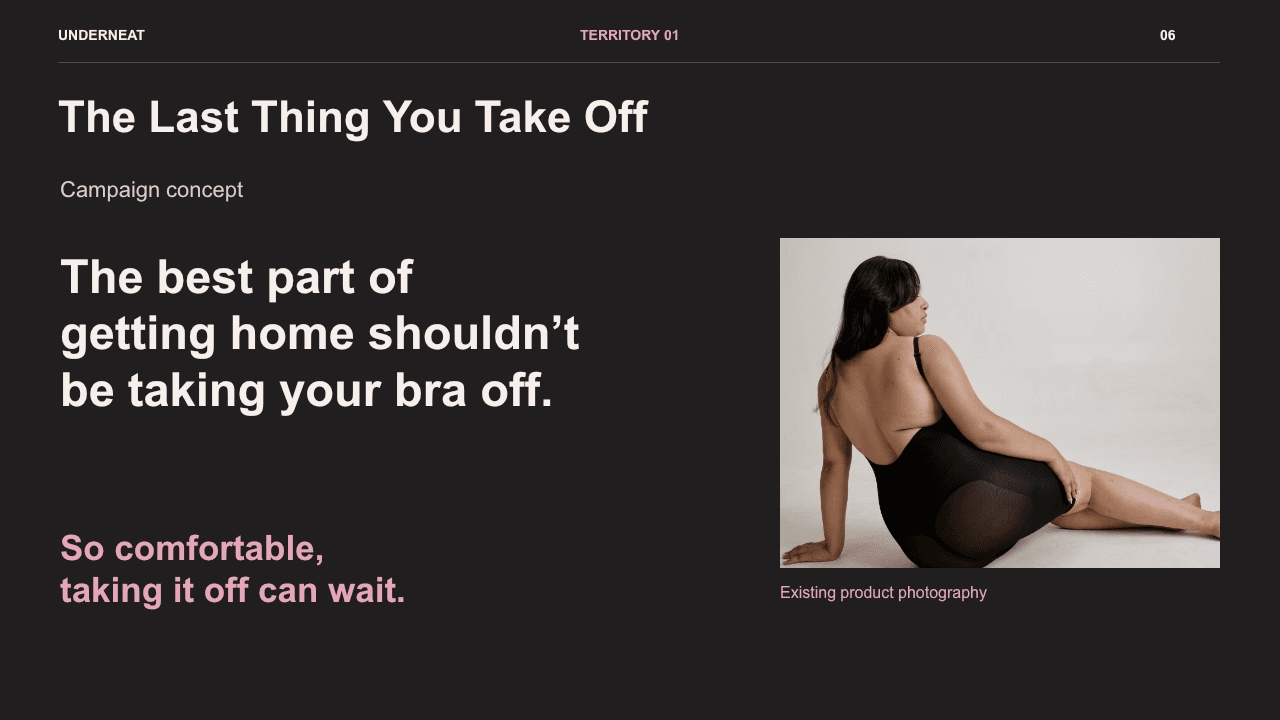
The Last Thing You Take Off
A getting-home ritual becomes the visual device for comfort.
My first territory reverses the familiar urge to remove uncomfortable innerwear after getting home. In the proposed film, shoes, earrings, a watch and the workday come off before the woman settles into the sofa. Her Underneat is the thing she never rushes to remove.
The line is ‘So comfortable, taking it off can wait.’ A repeatable creator format, ‘Things I Took Off Before My Underneat,’ adapts the same device to work, a wedding or travel. The product would need to substantiate that promise before production.
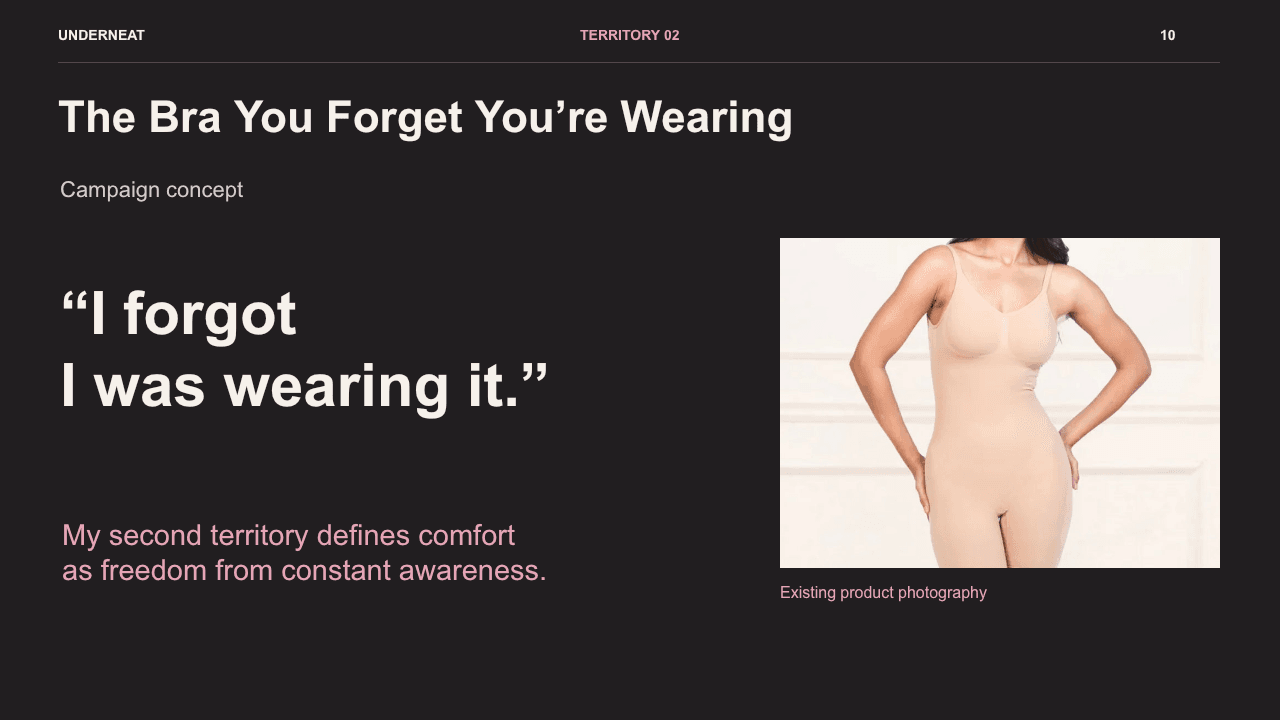
The Bra You Forget You’re Wearing
A quieter territory makes freedom from interruption the benefit.
The second territory focuses on attention. In the proposed film, a woman moves through a commute, a presentation, shopping, dinner and dancing. Asked how many times she thought about her bra, she answers, ‘I didn’t.’ That is illustrative dialogue, not a real testimonial.
The companion social format lists ‘Things I Thought About Today’ before the closing line, ‘My bra? Not once.’ This route gives comfort a quieter expression than the getting-home ritual while retaining a distinct creative mechanism.
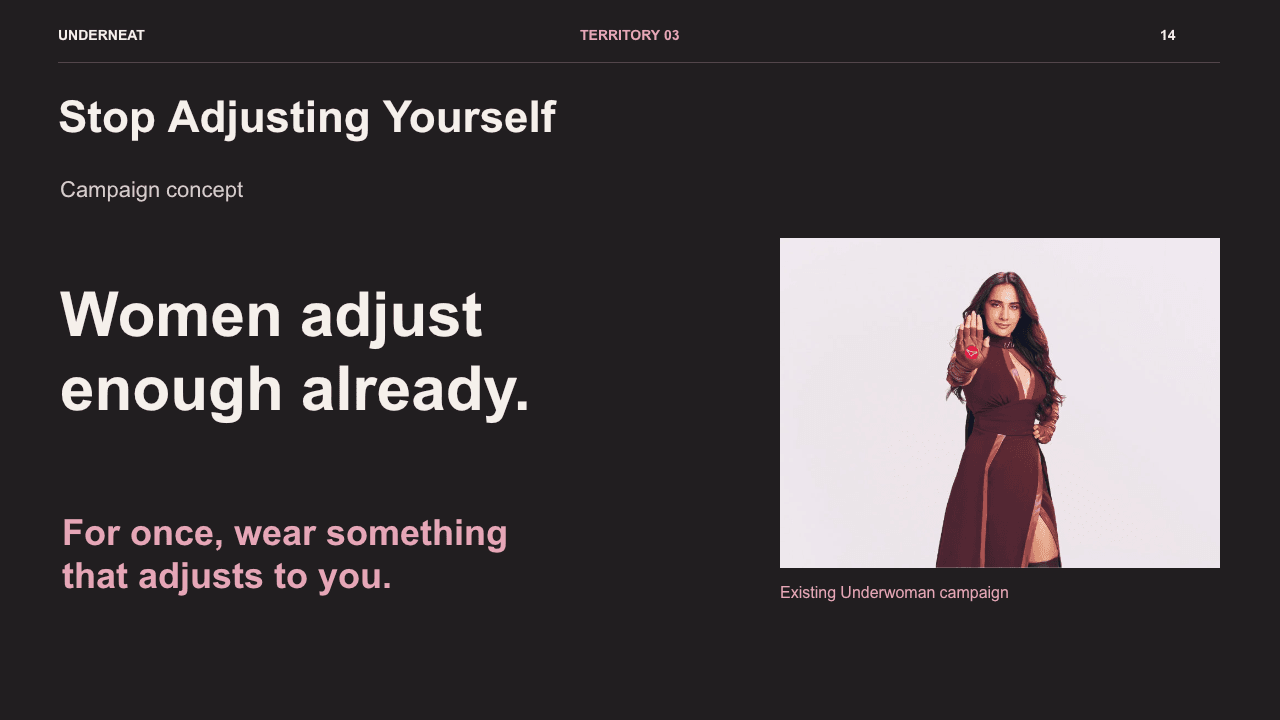
Stop Adjusting Yourself
Product friction connects to a wider cultural expectation, with limits.
The third territory connects physical adjustment with the wider expectation that women accommodate others: changing a tone, posture, outfit or behaviour. The proposed film repeats the word ‘Adjust’ through everyday situations, then pauses at a mirror.
The line is ‘For once, wear something that adjusts to you.’ Social participation begins with ‘What are you tired of adjusting?’ I would keep participation voluntary, request permission to reuse responses and moderate intrusive or body-shaming comments. A product should not claim to solve social pressure.
How I would choose and test
A proposed first test, not a claim that one idea already wins.
I would begin by testing The Last Thing You Take Off because it has a clear visual ritual and several natural occasions. I would keep the attention territory as an alternative and separately test whether the cultural territory feels relevant and credible.
Before a live campaign, I would confirm the customer language, selected product and substantiated claims. The test plan separates understanding and relevance from product visits, shopping behaviour and fit-related support. Baselines, production spend and success thresholds require a live brief, so I do not invent them here.
Evidence note: Independent strategy exercise based on my supplied document. Brand-owned photography from Underneat’s website provides reference context only. It is not my photography, an endorsement, or evidence that Underneat produced these proposed campaigns. No execution outcomes are claimed.